



The most valuable asset in the SpaceX IPO isn’t likely to be the stock.
It certainly won’t be the valuation.
In fact, the financial metrics Wall Street will obsess over in the first few weeks of trading are a distraction.
We will look back on the SpaceX IPO as the “tipping point of visibility” for the space industry and recognize it as one of the most important investment events of the decade.
Only Wall Street will care to remember its price-to-sales ratio, but that’s what you’re going to hear about right now.
Don’t let it cause you to ignore the gift.
This has happened before…
SpaceX was formed in 2002.
In 2025, SpaceX (SPCX) posted $18.7 billion in revenue and a $2.6 billion loss.
If it goes public at an expected valuation of $1.75 trillion, its price-to-sales ratio will be a nerve-racking 93.
For context, the S&P 500 and Nasdaq 100 are currently trading at price-to-sales ratios of about 3 and 5 respectively.
Here’s where SPCX will fall relative to today’s hot stocks, ordered by market cap…
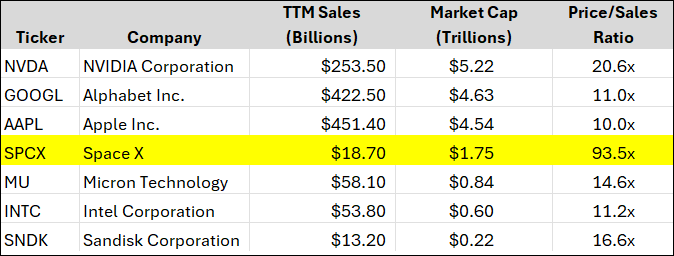
The size of the IPO measured in market cap is historic, but the valuation is not, and remember, the company is almost 25 years old.
In 1995, a long-forgotten company was formed and went public in the span of less than a year.
This company changed my life, and it changed your life too.
At the time of its IPO, this little-known company had only $16 million in sales and losses of $4 million, and the market rewarded investors with a valuation of $3 billion.
At that valuation its price-to-sales ratio was a staggering 187, which was double what SPCX is expected to IPO.
This piece of history is analogous to what’s about to happen with the SPCX IPO, and it is a gift to investors to see what’s coming before history repeats.
That company was Netscape.
Netscape introduced a user-friendly way to use the internet. It popularized the browser which is the application you most likely know today as Chrome, Safari, Firefox, or Internet Explorer.
The browser took a technology that had been developing for years and made it accessible and tangible for the public.
The Netscape IPO demonstrated to Wall Street that the internet was investible.
Netscape did not invent the internet. It didn’t even invent the browser. But its IPO helped investors see the internet as a commercial platform.
The SpaceX IPO is about to play a similar role for the space industry.
The Tipping Point of Visibility
Transformational technologies rarely arrive all at once.
They can spend decades becoming technically possible. Then they spend years becoming economically practical. Then, almost suddenly, a product, platform, company, or public event makes them visible and viable to the masses.
This is the tipping point of visibility.
It is not the birth of the technology. It is not the first invention. It is not even the first commercial use.
It is the moment when enough infrastructure, cost reduction, capital, public awareness, and measurable adoption come together to make the future easy enough to imagine and invest in.
History’s Repeatable Pattern of Massive Investment Opportunities
Major bull markets in industries follow a pattern.
First, a technology spends years or decades in a narrow, expensive, experimental phase. Most people ignore it because it does not yet touch their daily lives. Then costs fall, infrastructure improves, distribution expands, and one product or platform makes the technology tangible.
Suddenly, the niche technology enters a phase of mass adoption. Mass adoption leads to the development of more businesses and industries that leverage the leading technology.
Often the leading technology and/or the company that created it is not the biggest beneficiary of the change it set in motion.
For example…
Railroads
Born as a transportation technology. Initially expensive, localized, and infrastructure-heavy, they became transformational when networks connected regions, enabling companies and countries to leverage resources spread out over long distances. Second-order effects included steel, coal, land development, agriculture, retail distribution, and national markets.
Electricity
Known scientifically for centuries, but not economically transformative until generation, transmission, lighting, motors, and appliances made it usable at scale. The value was not just electricity companies. It was the entire electric economy.
Internet
Developed first through government, academic, and technical networks. It became mass-adoptable when browsers (Netscape), personal computers, broadband, search, e-commerce, and mobile access made it useful to ordinary people. The second-order winners were not only internet service providers, but software, advertising, cloud, payments, media, and logistics.
Smartphones / Wireless
Mobile phones existed for decades, but the smartphone turned wireless connectivity into a consumer platform. The bigger wave came from apps, mobile payments, ride sharing, social media, location services, and on-demand commerce.
AI
AI has existed since the 1950s, but for most people it felt abstract or invisible. Large language models (LLMs) made it tangible. ChatGPT productized LLMs and almost overnight, AI was being used by hundreds of millions of people directly.
The patterns are clear:
- A technological platform can take decades to develop and still feel newly invented once it becomes accessible, useful, and measurable.
- Enormous growth and investing opportunities occur across many companies and industries when the primary tech trend is adopted by the masses.
The SpaceX IPO
Space travel is not new. Rockets are not new. Satellites are not new. Commercial space is not new. Waging war from space is not new.
In fact, the space economy is probably already bigger than you realize.
NASA, defense contractors, telecom companies, satellite operators, aerospace engineers, and SpaceX have been building these capabilities for decades.
But for most investors, the space industry has not been a noticeable factor in our daily lives.
SpaceX going public will change that by shining a light on how close we are to what was once considered the distant future.
This IPO is going to take a niche industry and make it far more investible to Wall Street and mainstream in the minds of the public.
A public SpaceX will give investors a clearer window into launch economics, satellite broadband growth, capital spending, customer demand, government contracts, interplanetary colonization, and more.
So the “gift” this IPO is giving the average investor is the insight that insiders have known for a long time…
The space economy is enormous, growing, and undeniably the next frontier of growth investing.
As you can see from the chart below, produced by the U.S. Space Foundation in July of 2025, the space industry is not only enormous, it’s not what most people would think. Only 7.96% of the global space economy is related to U.S. Government Space Budgets.
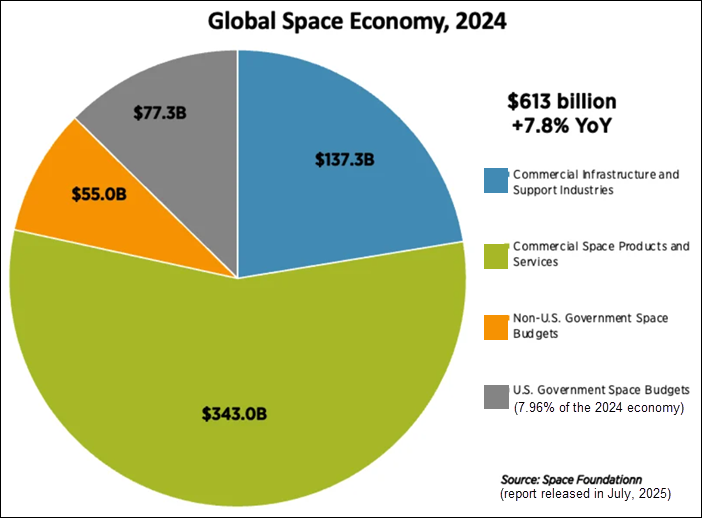
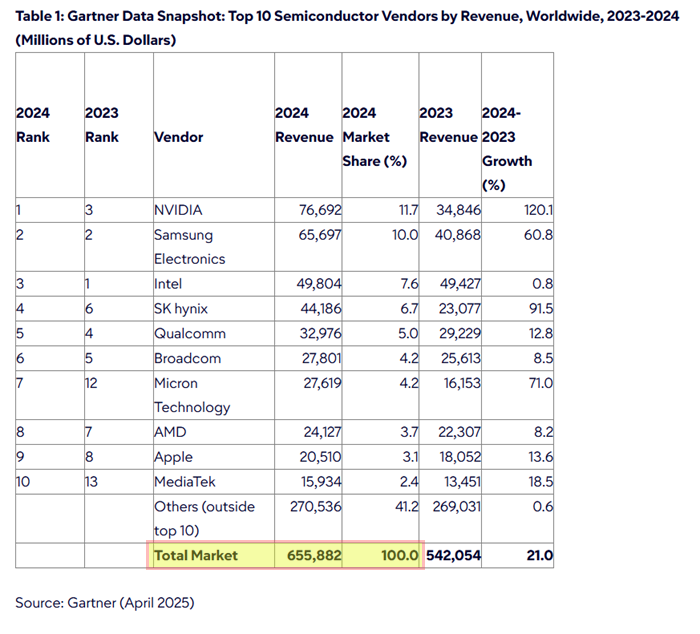
To put this in perspective, the semiconductor economy was roughly the same size at the same time. Space at $613 billion vs. semiconductors at $655 billion.
The future is here, and visibility matters.
The public may say, “Where did this come from?”
But you know it did not come from nowhere. It’s been hiding in plain sight.
ChatGPT wasn’t the invention of AI. It was the spark of mass adoption. Just two years after its public debut, there is a $2 trillion backlog of data center construction fueling industries that would likely otherwise be struggling.
In last week’s Market Outlook, “Tactical Strategy for The Rest of 2026.“
I explained that AI has changed the character of our economic growth. Historically economists have attributed 70% of demand to the consumer, but last quarter that changed…
“According to the Bureau of Economic Analysis, Q1 2026 GDP grew 2.0% and is estimated to have grown by 1.3 percentage points, or about two-thirds of that growth, can reasonably be attributed to the AI buildout using equipment-plus-software as the proxy.”
The space economy is about to have its ChatGPT moment. And the SpaceX IPO is the match.
What’s Elon’s pay package is really telling you
This is what the media is focused on. According to Reuters:
“The SpaceX board in January approved a pay package for the world’s richest man that will award 200 million in super-voting restricted shares if the company hits a market value of $7.5 trillion and establishes a permanent human colony on Mars with at least 1 million people.”
“His Mars-shot performance package also gives him as many as 60.4 million in restricted shares if SpaceX meets separate valuation goals and operates data centers in space that provide at least 100 terawatts of compute capacity – a colossal amount of power equal to 100,000 gigawatts, or about 100,000 one-gigawatt nuclear reactors running all at once.”
Most people will focus on the potential dollar value of Elon’s additional 260.4 million shares of stock. That’s a mistake.
Elon has clear incentive to make interplanetary colonization and data centers in space a reality on a large scale.
Does that mean buying the IPO at 93 times sales is a good idea?
YES, if the market believes SPCX will grow into its valuation.
NO, if the market uses the IPO as a liquidity event.
If the stock is 30% higher than its IPO price, over 50% of pre-IPO shares will be unlocked or eligible for sale. If those shares hit the market, it may create a significant drawdown for both the stock and the market. However, any large drawdown will likely create an opportunity for investors who know how to read the market.
Timing this trade is not the focus of this article. We do that in almost every other Market Outlook.
What Investors Should Learn From Steve Jobs
Here’s what most people miss about the Apple story.
In 1997 Jobs didn’t come back to Apple to build better computers. He said so himself. He came back to build great products for people. These products happened to be powered by technology. Jobs was deliberate and very vocal about this.
Jobs didn’t want Apple defined by its technology. He wanted it defined by what that technology made possible for people.
This guiding principle is why Apple grew into something far bigger than a computer company ever could have been.
That’s why the stock went from $0.11 (when he returned to Apple) to over $300 today.
Now look at Elon’s compensation package again. He doesn’t get paid for building better rockets. He gets paid if SpaceX establishes a permanent human colony on Mars with a million people, and operates data centers in space powerful enough to run 100,000 nuclear reactors worth of compute capacity.
That’s not a rocket company. That’s infrastructure for a new civilization.
Elon isn’t building a launch business any more than Jobs was building a computer business. He’s building the platform that humanity will run on next. The rockets are just the means. The destination is literally and figuratively is the point.
This hasn’t been a secret. It’s literally in the SpaceX mission statement:
“To build the systems and technologies necessary to make life multiplanetary, to understand the true nature of the universe, and to extend the light of consciousness to the stars.”
The IPO will make SpaceX and all its technological goals more transparent and accelerate the development of the space economy in mindshare and investment dollars.
This is the “Think Different” moment for space.
And just like 1997, too many investors will look at the financials, shake their heads at the valuation, and miss it entirely.
This is the gift this IPO is giving you.
My opinion is that 5–10 years from now, SPCX will be much higher than its IPO price and any price it reaches in 2026.
SPCX won’t be the biggest percentage winner in the industry over the next 5 or 10 years, but it may be the safest.
There will likely be dozens, if not hundreds, of companies in the space industry that reward investors with higher returns than SPCX. But managing your risk with them will require real trading skills so you avoid the companies that go bankrupt.
SPCX will undeniably deserve the credit for ringing the bell that savvy investors know means: now is the time to pay attention.
You have time to decide when and how to pick your entry for SPCX. You have time to build your list of space stocks to follow.
But don’t procrastinate. The bell is ringing.
Try to consider what it will take to build a colony of one million people on Mars. It’s more than rockets. It’s a nation.
It will require new forms of manufacturing, agriculture, energy, medicine, communications, and logistics at a scale that makes the AI data center buildout look like just a piece in a bigger puzzle.
AI is just a fraction of what the space economy will become.
If Wall Street and Main Street adopt space as a legitimate source of opportunities, resources, products, and services…
The AI revolution is small.
The semiconductor industry is even smaller.
And SPCX is just the beginning, not the “answer.”
Don’t ignore it.
It’s not new, but now is the best time to get going. Mass adoption of this industry is about to take off in ways that are impossible to predict.
Buying SPCX on the day of its IPO may be a difficult decision. But waiting for an entry point where you can control your risk, and perhaps get a better price than the IPO, is not that hard with the MarketGauge PRIME method.
If you want help tracking the opportunities, keep reading this weekly Market Outlook. For more detailed analysis, get our free MarketGauge Opportunity Report.
The greatest investment opportunities rarely come from seeing the present more clearly.
They come from learning how to see the future before everyone else has a framework for it.
If you can identify a tipping point of visibility, you’ll know where to focus your attention, and more importantly, when to think different.
Consider the SpaceX IPO the next big tipping point of visibility.
If You’d Like To Build Your Wealth or Your Clients’ with MarketGauge Strategies and Systems
If you’d like access to the MarketGauge indicators, strategies, automated trading models, and more, contact us.
- For individual traders or those who want access to professional-grade models: marketgauge.com/call, and ask Rob how to join our Active Investing Edge program
- If you’re an asset manager or RIA seeking algorithmic systems: email Ben at ben@marketgaugepro.com
- Use Big View (a lot of it is free!)
Best wishes for your trading,
Geoff Bysshe
Co-Founder
(Connect on LinkedIn)
 |
| Every week we review the big picture of the market’s technical condition as seen through the lens of our Big View data charts.The bullets provide a quick summary organized by conditions we see as being risk-on, risk-off, or neutral.The video analysis dives deeper. |
Summary: Markets remain in a broadly bullish risk-on environment, with the DOW making new highs, volatility falling to its lowest levels since January, and leadership from semiconductors, retail, and growth stocks supporting continued upside momentum across both domestic and international equities. However, mixed internals, weak breadth divergences, rising rate volatility, and lagging crypto and communication sectors suggest underlying participation remains uneven and could lead to short-term consolidation despite the strong headline indexes.
Risk On
- Markets are just fractionally off new highs with the DOW making new highs. The real motion readings are also healthy and not overbought on the daily, though on the weekly charts, real motion is running a little rich, especially on QQQ and SPY. (+)
- Sectors were nearly all up with the exception of Gold Miners and communications. We had a very important bounce in retail, which was up over 4% on the week, and continued parabolic moves in Semiconductors. (+)
- Volatility hit its lowest levels since January. Risk on. (+)
- Risk gauges remain at 80%, though the wood/gold ratio is looking to flip positive. (+)
- Value put in new all-time high with growth leading. (+)
- Emerging and developed markets look strong with both in bull phases and modest real motion values. (+)
- The modern family responded well this week with retail regaining its 50-Day moving average and bouncing off of its triple bottom/six-month lows. (+)
- Seasonal trends remain bullish for the next couple of months, though late May can experience a little weakness. (+)
Neutral
- Volume was mixed, with strong accumulation in DIA in contrast with QQQ with no accumulation days in the last two weeks. (=)
- The market internals are giving a mixed read, with the McClellan Oscillator right at the mid-point, up down volume looking good, but Advance-decline weak – a divergence as the market hits new all-time highs. (=)
- The new high new low ratio still looks shaky with the 10 under the 21 day. It’s showing some short-term strength but the longer-term trend is still negative. (-)
- The color charts (moving average of stocks above key moving averages) improved to a neutral reading with the QQQ looking positive. (=)
- Soft commodities sold off sharply this week, but still in a bull phase and now underperforming the SPY–potentially indicating some easing of inflationary pressures and should be positive for the market. (=)
- Rates spiked to 20-year highs before coming off those sharply, possibly signally a trend reversal. (=)
- Crypto continues to show low correlation to the overall market, with it being down and still well off highs even as the market pushes new highs. (=)
Risk-off
- Oil closed lower on the week, showing potential easing of concerns in the gulf, though still quite elevated. One important thing to note is that momentum flipped negative for the first time since early 2026 so if we take out 130 in USO that could reverse our risk off read for the markets based on oil (-)
Actionable Trading Plan
The market remains in a constructive risk-on environment, so the primary strategy is to stay net long while becoming more selective and tactical as momentum stretches on the weekly timeframe and internals remain mixed. Focus on buying pullbacks rather than chasing extended names, particularly in leading areas such as Semiconductors, Retail, Growth, and selective international exposure, while maintaining tighter risk controls given weakening breadth and elevated rates volatility.
Tactical Positioning
- Maintain an overweight toward:
- Technology and Semiconductors
- Consumer Discretionary/Retail
- Growth with selective Value exposure
- Developed and Emerging Markets
- Underweight or avoid:
- Communications
- Gold Miners
- Weak breadth/lagging speculative areas
- Overextended commodity trades
.
Entry Strategy
- Prefer entries on:
- Pullbacks into the 10-day or 21-day moving averages
- Short-term volatility spikes
- Retests of breakout levels
- Avoid aggressively chasing:
- Parabolic semiconductor moves
- Extended mega-cap growth after large gaps higher
.
Risk Management
- Raise trailing stops modestly tighter than normal due to:
- Weak advance-decline data
- Lack of accumulation in QQQ
- Fragile new high/new low readings
- Weekly momentum becoming extended
- If SPY or QQQ lose their 21-day moving averages on heavy volume, reduce exposure incrementally rather than all at once.
.
Rotation Watch
Key signals to monitor over the next 1–2 weeks:
- Retail holding above its 50-day moving average would confirm improving consumer participation.
- A positive flip in the wood/gold ratio would strengthen the broader risk-on case.
- Falling rates after the recent spike could fuel another leg higher in growth.
- Continued deterioration in breadth while indexes make new highs would raise the odds of a sharp short-term correction.
.
Tactical Opportunity
Volatility at multi-month lows favors:
- Selling into euphoric upside extensions
- Buying controlled dips
- Avoiding excessive hedging costs unless volatility expands meaningfully
.
Portfolio Stance
Current environment favors:
- Moderately aggressive exposure
- Tactical trend following
- Incremental profit-taking into strength
- Keeping some dry powder available for late-May seasonal weakness or breadth-driven pullbacks