




- Currently, the media and stock market are hyper-focused on the relationship between the price of oil, driven by the damage caused by the Iran war, and expectations for an “end date” for the fighting. If or when the fighting stops, the next focus will be on how quickly international trade recovers and how depleted importing countries’ critical resources, such as oil and fertilizer, are. OECD oil inventory data may become your new favorite indicator.
- There are three common ways market corrections and bear markets bottom out. The first is quick and violent capitulation. The second is confusing sector rotation, and the third is through a long depression of investor sentiment, combined with compressed price action. The investors and the media are looking out for capitulation (number 1), but the market is saying it prefers rotation. There are a few indicators that enable you to measure the market’s attempt to bottom out this way.
- Despite all the bearish news, earnings expectations for the S&P 500 have not only risen since the beginning of the year, but they’ve also risen since the start of the war. There’s always a bull market somewhere, and we’ll analyze the fiber optic stocks GLW, CIEN, and AAIO with the PRIME Method of stock selection, which we introduced in last week’s Market Outlook.
Where Persistence Has Become A Big Problem
If you’ve been following this article over the last several weeks, you may have noticed a theme that focuses on the importance of time as an influence on market behavior.
- The market’s time in a trend period has an effect.
- Investors’ patience with the trend period has an effect.
- Investors’ reactions to time are often gradual, then excessive.
Time in a trend affects sentiment, positioning, and more.
The fundamental factors behind the market’s trend are also likely to be affected over time, as is the case with the persistence of the Iran war and the elevated price of oil, both together and independently.
Few would argue that the higher price of oil, driven by the war has depressed stock prices and expectations for global economic growth, but how quickly the market and economies will recover should the war come to an end in the next week, month, quarter, or longer is debatable.
However, the longer the war goes on, keeping oil prices elevated, oil production declining, and the flow of oil to importing countries curtailed, the bigger the problem becomes.
Higher oil prices are an obvious problem, so when the war ends, the next obvious question will be, When and for how long will oil prices fall?”
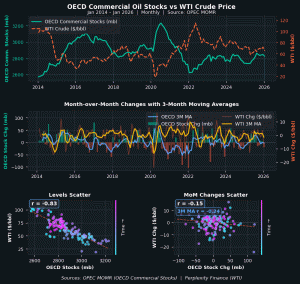
There’s never one reason for a price trend, but below you’ll find a visual analysis of the relationship between the changes and levels of OECD Oil Inventory Data and the price of crude oil. Note that this data excludes strategic reserves in order to put more focus on the open market source of oil.
As you can see there are three measures.
The top chart shows the level of commercial stocks (inventory excluding strategic reserves) and the price of oil. It’s clear that the price of oil is inversely correlated with the level and trend of inventories.
The middle chart shows month-to-month changes in inventory along with a three-month average of the monthly changes and the price of oil. Again, the price of oil is highly correlated with the 3-month average trend and level of inventory changes.
The bottom row has two charts that give the correlation data for the one-month period and the total level. Here you can see clearly that one-month changes aren’t a problem, however, the cumulative impact over time is highly correlated.
A persistent trend of declining inventories is a problem that leads to persistently higher oil prices.
In case you didn’t notice, the reporting of data lags by a couple of months. So while this is the most recent data, it doesn’t include the impact of the war.
How Will This Market Bottom?
There are three common ways market corrections and bear markets bottom out.
- The first is quick and violent capitulation.
- The second is a process of sector rotation, and
- The third is through a long depression of investor sentiment, combined with compressed price action.
The investors and the media are looking out for capitulation (number 1), but the market is saying it prefers rotation right now.
In other words, while the market is trading like a bear market and the media’s reports often sound dire, the market is not selling everything in a rush of capitulation.
If you’re only looking at the S&P 500 or NASDAQ 100, it may feel like capitulation is underway, but the broader market tells a different story.
As a result, the process of sector rotation can indicate when the market has bottomed and or when the market slides into a state of capitulation.
When Will This Market Bottom?
In last week’s Market Outlook, we introduced the PRIME Framework for analyzing a market’s trend to determine whether it is likely to continue or reverse.
As with most good frameworks or methodologies, it has basic principles you can use immediately to improve your market analysis. Additionally, with experience, you’ll discover several levels of detail that make the PRIME Method even more powerful.
The basics look like this.
The PRIME framework is based on 5 primary conditions that influence a stock’s or market’s trend. They are as follows:
- Price trends and patterns: Market moves create and enhance emotions like fear, greed, confidence, hope, etc.
- Relative performance: The best and worst performing stocks attract investors’ attention.
- Institutional buying and selling: The largest, most durable trends are driven by institutions.
- Momentum: Prices and investor emotions have a measurable momentum factor that contribute to the strength of a trend.
- Expected Earnings Growth: The foundational reason for owning a stock is based on a belief that the company will grow its earnings and value.
The PRIME method provides a simple way to measure all five elements:
- Price Trend & Patterns: Market Phases indicators
- Relative Performance: Triple Play Leadership indicators
- Institutional Accumulation: Triple Play Volume Trend indicators
- Momentum: Real Motion indicators
- Expected Earnings or A Growth Story: This is more subjective.
This market will have established a reliable bottom when three of the four top PRIME criteria are bullish in the indexes, and or when several growth-oriented sectors are also in bullish conditions based on the PRIME criteria.
On Monday morning, in our live mentoring service, I reviewed the major sector from the PRIME perspective. We’ve posted a recording of that analysis as this week’s Market Outlook video.
Here are a few sector charts explained.
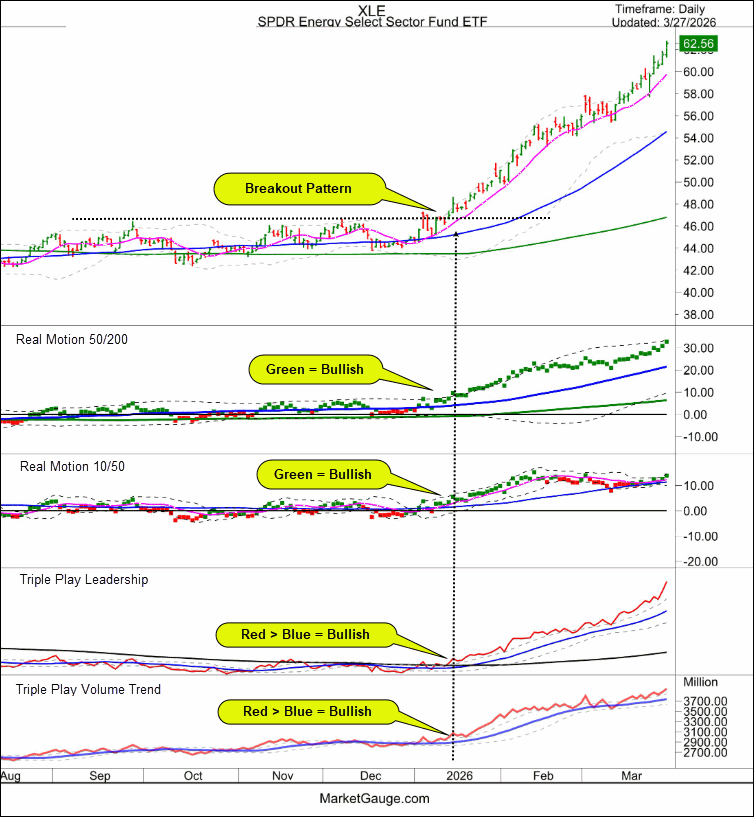
XLE, the energy ETF, is a good example of what a clear breakout looks like with all the PRIME indicators in a bullish condition. The charts that follow are not very bullish, but they are showing signs of holding or turning in a market where the indexes (SPY and QQQ) are very bearish.
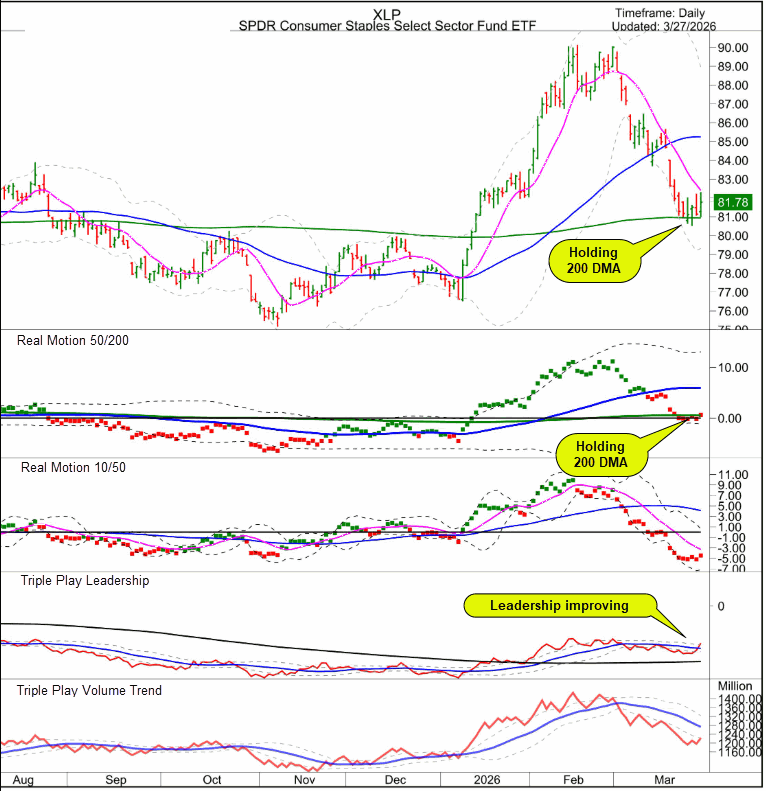
XLP, Staples, is a defensive sector, but it’s holding its 200 DMA while the market trades much lower than its 200 MA. Real Motion moving averages often identify support areas, so the Real Motion chart on the 200 MA is significant.
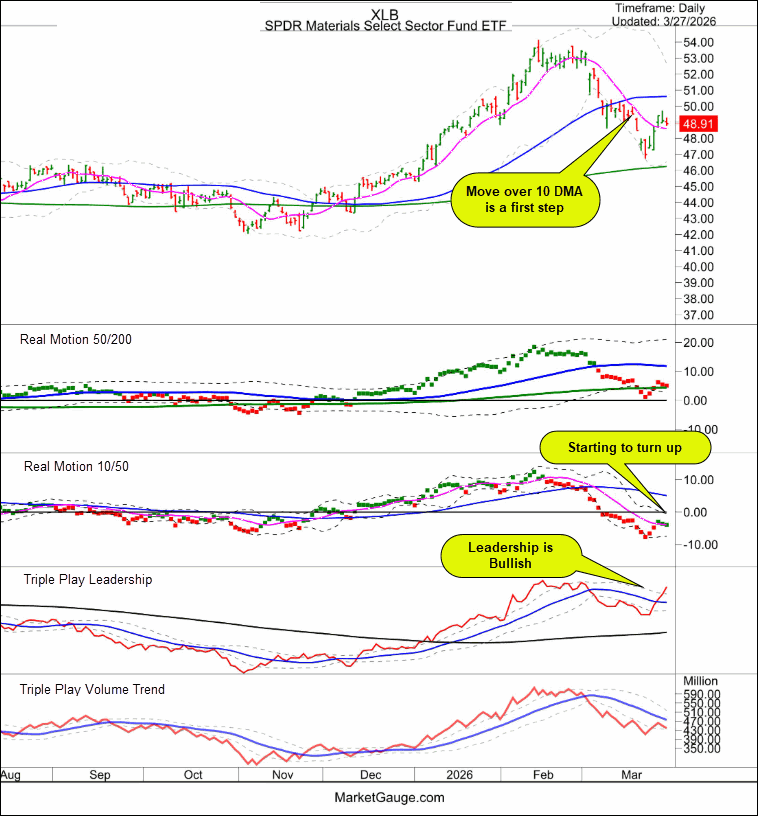
XLB, Materials, has moved over its 10 DMA and the Real Motion 10/50 momentum indicator’s green dots confirm there may be enough momentum to continue higher.
Additionally, the leadership indicator has a bullish reading, which suggests the sector’s improving price action is NOT a result of following the market. This conclusion is easy and obvious in the current bearish market environment, but when the market is trending higher, a leadership indicator with this pattern highlights the strongest trends.
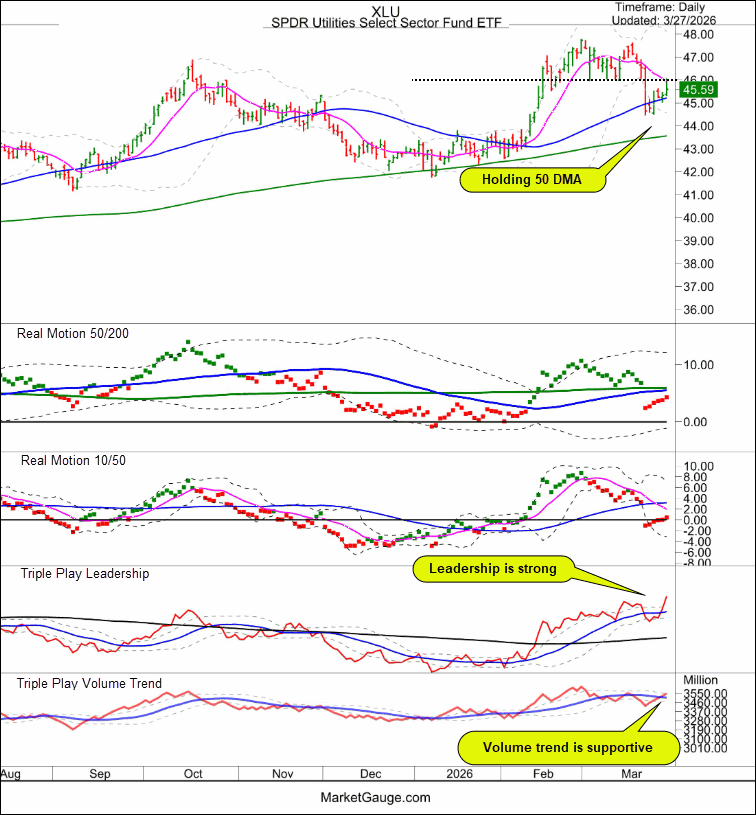
XLU, utilities broke down below the important support shown by the dotted line. However, it held its 50 DMA and maintained its strong leadership condition. If XLU trades over its 10 DMA and the resistance of the breakdown level, Real Motion is in a position to turn bullish, which would create a very bullish chart.
For more detailed analysis on more sectors, watch this week’s Market Outlook video below.
You can also access the charts shown here for free every day under the Big View Sector Summary Table.
Stocks That Can Do Well Now and When The War Ends
One way to apply the PRIME method is to focus on stocks in leading trends with a compelling growth story.
The AI driven trend of data center construction has created enormous growth prospects for the Fiberoptics industry. Three companies that are well positioned to experience strong growth for the foreseeable future in this industry are GLW (Corning, Inc), CIEN (Ciena Corp.) and AAOI (Applied Optoelectronics, Inc.).
Despite the war and weak market, these stocks have had large moves higher over the last month. As you’ll see in their charts below, they all pushed higher with “all bullish” PRIME conditions.
Timing trades is based on price patterns and trading strategies. The PRIME indicators highlight when the conditions for a strong trend or reversals exist.
In the last week, these stocks have begun to pull back, and some of the PRIME conditions have turned bearish.
This creates opportunities to buy a correction in a strong long-term trend when the intermediate and/or longer-term trend resumes its up move as defined by the PRIME indicators.
Below you’ll find a quick analysis similar to what we did on the sector charts above. You’ll also find links to a report with more extensive analysis.
GLW, Corning, Inc
GLW has a strong growth story.
- Strong revenue acceleration in 2025 — FY2025 revenue surged 19% to $15.6B, the best growth in years, driven by the Optical Communications segment benefiting from AI data center buildout. Estimates call for FY2026 revenue of $18.8B (+20%) and FY2027 of $21.4B (+14%).
- EPS poised for a major step-up — Consensus FY2026 EPS of $5.09 represents a 174% increase over FY2025 GAAP EPS of $1.86, reflecting both operating leverage and absence of one-time charges. The 5-year CAGR (FY2020–FY2025) stands at 28.0% on EPS.
- Reasonable valuation given growth trajectory — Forward PE of 28.7x on FY2026e EPS and P/S of 8.0x TTM revenue are moderate for a company with 20%+ revenue growth and expanding margins. The trailing PE of 80x reflects depressed FY2024/2025 GAAP earnings.
- Consistent quarterly EPS beats — All four recent quarters showed adjusted EPS beats vs. consensus, with revenue generally in-line. Q3 2025 GAAP EPS was impacted by a non-cash impairment charge (negative GAAP EPS), but adjusted EPS remained positive.
It’s technicals have deteriorated but they could recover quickly:
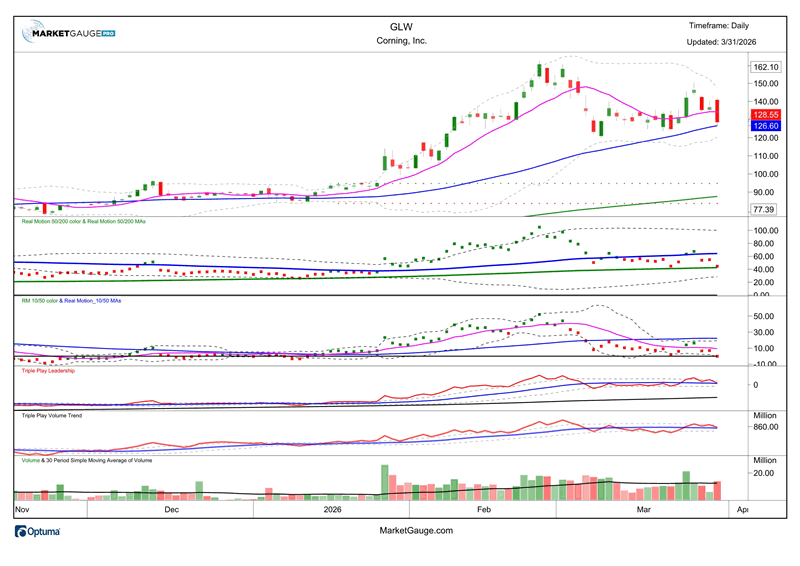
The weakness in the market over the last 2 days has pulled GLW back under the 10 DMA (magenta) and down to the 50 DMA.
Warning: Both Real Motion indicators have red dots (bearish) under their 50 DMA while the price chart sits over its 50 DMA. This condition suggests that if the price breaks its 50 DMA, it will continue lower.
However, if price moves back over its 10 DMA and the Real Motion charts turn green, everything will be in gear for a new move higher.
For a more detailed analysis, go here
AAOI, Applied Optoelectronics, Inc
- Explosive revenue growth in 2025 — Full-year 2025 revenue surged 83% to $455.7M from $249.4M in 2024, driven by strong data center demand for optical interconnects. Consensus estimates project ~$962M in 2026 (+111%) and ~$1.88B in 2027 (+95%).
- Company approaching profitability — While all historical EPS figures are negative, AAOI posted only -$0.04 EPS in Q4 2025 and analysts estimate positive net income beginning in Q2 2026 (~$0.06/share). Full-year 2026 consensus EPS estimate is ~$0.95.
- Elevated P/S valuation reflects high growth expectations — At a price/sales ratio of 18.9x on TTM revenue, the stock is priced for continued hyper-growth. P/E, PEG, and forward multiples are not meaningful given recent losses.
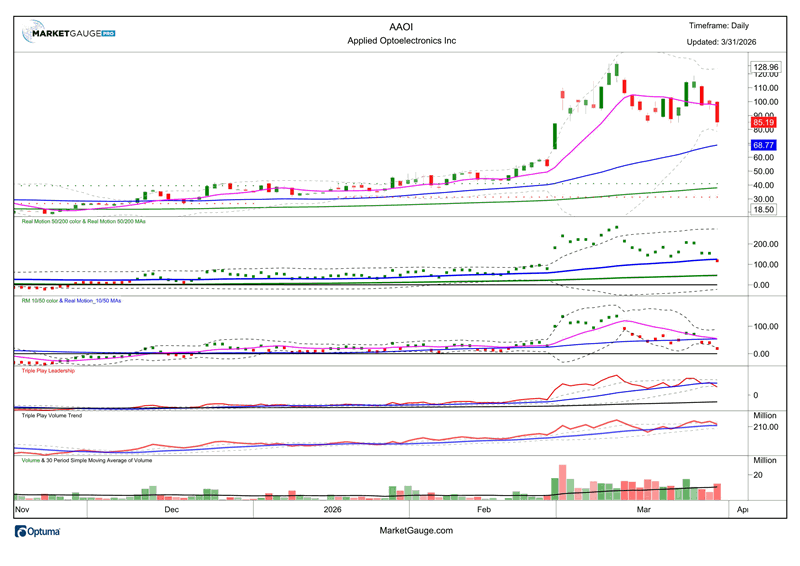
AAOI has a very similar situation as GLW above, but its momentum is stronger, and it’s further from its 50 DMA.
If it climbs back over its 10 DMA and the $100 level that has been pivotal, the price action will suggest it’s ready to move higher. If that happens with bullish reading in leadership, volume, and Real Motion, it will have all the ingredients of an explosive growth stock.
For a more detailed analysis, go here
CIEN, Ciena Inc.
CIEN’s growth story is strong, but it’s led by its sales growth:
- Explosive EPS recovery expected in FY2026: Consensus estimates call for EPS of $7.48 in FY2026 vs $0.87 in FY2025, a ~760% surge. This reflects anticipated acceleration from AI-driven data center buildouts and strong demand for coherent optical networking infrastructure.
- Revenue inflection in progress: 5yr Sales CAGR of 6.2% understates recent momentum: FY2025 revenue of $4.77B was up 19% YoY, and TTM revenue reached $5.12B. Consensus projects $6.1B in FY2026 (+28%) and $7.35B in FY2027 (+20%).
- Consistent EPS misses, strong revenue beats: In each of the last 4 quarters, actual EPS came in below consensus estimates. Revenue, however, beat expectations in all 4 quarters, suggesting strong top-line execution but elevated cost structures weighing on GAAP profitability.
- Rich valuation discounts near-term earnings, prices in a recovery: At a PE of 275x on trailing EPS of $1.59, the stock price of $437.70 is almost entirely forward-looking. The forward PE of 58.5x (on FY2026 est. EPS of $7.48) and P/S of 12.1x reflect high investor confidence in the AI-capex tailwind.
Its technical setup is also very strong:
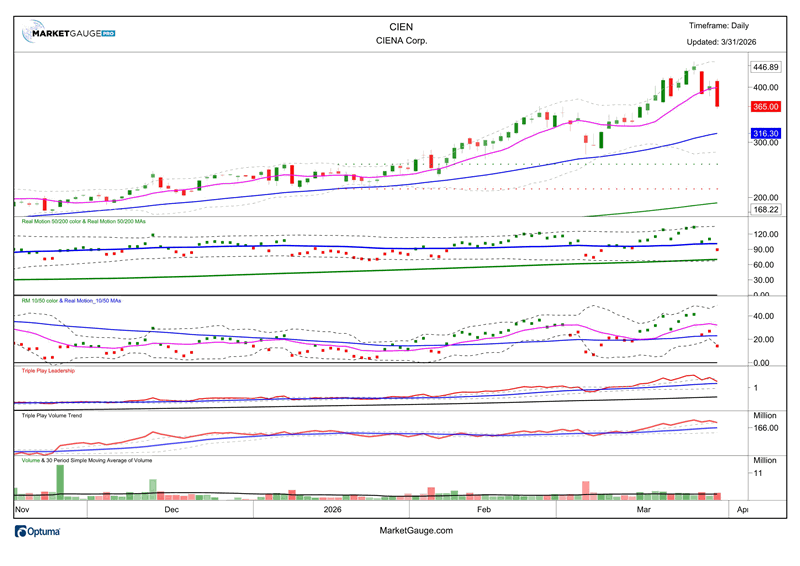
CIEN has had a very consistently strong 2026, as seen by its Leadership and volume trend indicators, having a solid trend, and the red line remaining well above the blue line.
The recent pullback under the 10 DMA has landed right on a good level to bottom – the support of the $360 level, which was its February swing high.
Leadership and volume trend remain bullish and while the Real Motion momentum measures have turned negative, they are at levels that are likely to be support. If CIEN gets back over its 10 DMA and $400, it’s likely that everything will be lined up for a continued move higher.
For a more detailed analysis, go here
As the market corrects, you can see if these 3 stocks and other market leaders are ready to resume their uptrend by looking at how their PRIME trends hold up or deteriorate.
Want Help Making Sure You See What’s Coming?
If you’d like access to the MarketGauge indicators, strategies, automated trading models, and more, contact us.
- For individual traders or those who want access to professional-grade models: marketgauge.com/call, and ask Rob how to join our Active Investing Edge program
- If you’re an asset manager or RIA seeking algorithmic systems: email Ben at ben@marketgaugepro.com
- Use Big View (a lot of it is free!)
Best wishes for your trading,
Geoff Bysshe
Co-Founder
(Connect on LinkedIn)
 |
| Every week we review the big picture of the market’s technical condition as seen through the lens of our Big View data charts.The bullets provide a quick summary organized by conditions we see as being risk-on, risk-off, or neutral. The video analysis dives deeper. |
Summary: Despite markets making new lows and broad risk-off signals dominating—rising volatility, weak breadth, sector rotation into defensives, and higher rates—there are modest signs of stabilization with improving internals, resilient “modern family” components, and relative strength outside the U.S. Overall, conditions remain pressured and oversold with a bearish tilt, but divergences and seasonal tailwinds suggest the potential for a near-term bounce rather than continued straight-line downside.
Neutral
- With the market making new lows, the market internals are giving a weak divergent reading with up down volume and advance decline improving week over week and McClellan Oscillator holding last week’s levels. (=)
- Risk gauge is showing neutral with the relative strength in rates and weakness in metals. (=)
- The modern family held up relatively well this week, holding last week’s lows across the board while the broader market broke down. Many are still outperforming the S&P and oversold on Real Motion. (=)
- Emerging and developed markets are trending lower but put in more of an inside week and held up better than the US markets. (=)
- Seasonally, we are past the typical February and March weakness and April tends to pick up. (=)
Risk Off
- Volume patterns lean heavily towards distribution in all except IWM which is more neutral. (-)
- Three of the four indexes made new recent lows on the move this week. They are each below their 200-Day Moving Average and oversold on real motion. (-)
- Sectors skewed risk off with Technology, financials hit the worst while risk-off sectors like Utilities and consumer staples were up. (-)
- New high new low closed slightly above last week’s levels, though still a negative reading overall. (-)
- The color charts (moving average of stocks above key moving averages) continues to trend lower. (-)
- Volatility made a new high this week, highest reading going back to April 2025. It is overbought though not at extreme levels. (-)
- Growth plummeted this week even as value maintained its relative value and still holding its 200-Day Moving Average. (-)
- Soft commodities push higher signally inflationary pressure. (-)
- Oil closed at a new high with continued concern over middle east conflict. (-)
- Rates continued to trend higher as the Fed is handcuffed and markets are expecting higher rates. (-)
Actionable Trading Plan
Core Positioning (Bias: Risk-Off but Oversold Bounce Potential)
- Maintain a defensive posture overall, but be prepared to tactically deploy into a short-term bounce rather than pressing shorts at current extremes.
- Favor value over growth and defensive sectors (utilities, staples) while growth remains weak and below key trend structures.
What to Do Now
- Reduce or avoid new short exposure unless markets re-accelerate lower—conditions are already stretched with volatility elevated.
- Look to scale into strength (not weakness) in areas showing relative resilience: select “modern family” leaders and non-U.S. equities that held up on the breakdown.
- Keep position sizes smaller than normal given elevated volatility and unstable breadth.
Bounce Strategy (Primary Opportunity)
- Expect a reflex rally driven by oversold conditions + seasonal tailwind (April).
- On a bounce, sell into strength in weak sectors (tech, financials) rather than chasing upside.
- Use the bounce to rebalance toward stronger themes (defensive/value, commodities with inflation tailwinds).
Risk Management
- Respect that rates + oil + inflation pressures = headwind for equities, so avoid overcommitting to risk.
- If volatility continues to expand or breadth fails to confirm a bounce, tighten exposure quickly and raise cash.
- Stay flexible—this is a trading environment, not a trend-following one right now.
Tactical Tilt
- Slight overweight: defensives, value, select commodities
- Underweight: growth, high beta, rate-sensitive equities
Bottom Line
Play for a short-term bounce within a broader risk-off regime, using strength to de-risk and reposition rather than assuming a durable trend reversal.
A Different Weekly Video: This is an excerpt from the Monday mentoring session from the Active Investing Edge membership